

Did you know? You can go to any day’s “This Day in History” page by simply entering the month and date after www.begintoinvest.com/
For example: www.begintoinvest.com/May-9
Or follow Begin To Invest on Twitter or Facebook for daily posts!
Prefer video? These are posted daily on our YouTube Channel (and embedded below)
Quote of the Day
However, Fed leaders did not take steps to raise interest rates to fight inflation. Congress created the Fed as an independent central bank to isolate it from political pressure, but during the war monetary policy was beholden to the needs of the Treasury. “Independence was sacrificed to maintain interest rates that lowered the Treasury’s cost of debt finance,” Meltzer (2003) writes.
– From “Federal Reserve’s Role During WW1” on FederalReservehistory.org. The book referenced by Allan Meltzer is his monumental chronical of the Federal Reserve, A History of the Federal Reserve
The independence of the Federal Reserve system has always been an important feature of the central bank. From time to time that independence has been under attack, leading to a lot of fear mongering by the media and financial blogs. I think it is interesting to note that there have been other times in history when the Federal Reserve very clearly stepped outside its usual operations at the pressure of the U.S. Treasury.
One of those times was in during World War 1, when the Federal Reserve kept interest rates low, despite rising inflation, to help the U.S. Treasury finance World War 1.
August 10th – This Day in Stock Market History

August 10th, 1914 – The first Federal Reserve Board sworn in
The Federal Reserve (the third central bank in the nation’s history) was created by law on December 23rd, 1913.
Just 8 months later, the world would be thrown into the chaos of World War 1. America scrambled to get the Federal Reserve system in place and operational while the nation’s finances were rapidly deteriorating. On this day in 1914, a major step in the creation of the Federal Reserve system took place, by appointing a board to the new Federal Reserve.
The newly created Federal Reserve did not have an easy opening act. Gold was flowing into the U.S at massive rates as Europe paid for supplies and armaments, and investors moved assets overseas. The flood of gold lead to a massive increase in the U.S. money supply and a bout of high inflation in the U.S. The first 5 years of the Federal Reserve’s history would be managing the nation’s monetary system as the great war raged, and government spending, and debt, skyrocketed.
See our Reads of the Day below for more in depth articles on the history of Federal Reserve during this time.
The New York Stock Exchange had been closed since July 30th, 1914 due to the outbreak of World War 1.

August 10th, 2007 – Early Tremors of the 2007–08 Crisis as the federal reserve warns of “unusual funding needs because of dislocations in money and credit markets”.
On this day in 2007, an under-the-radar event signaled the start of the global financial crisis.
The credit markets were seizing up due to subprime mortgage losses, and that day the U.S. Federal Reserve took the extraordinary step of issuing a public statement that banks were facing “unusual funding needs” and pledged to provide cash as necessary.
This was the first major central bank intervention of the crisis, coming just after a French bank froze subprime-exposed funds.
“The complete evaporation of liquidity in certain market segments of the U.S. securitization market has made it impossible to value certain assets fairly, regardless of their quality or credit rating.” — BNP Paribas press release, August 9, 2007
This sentence is arguably the opening line of the global financial crisis. It captures the core theme of the 2007 event: the problem was not that assets were known to be worthless, but that they had become unpriceable — opacity, not default, froze the system.
Stocks and credit markets were jittery as investors realized the contagion risk in the financial system from subprime mortgages.
U.S. stock markets would continue rising for another 2 months. On October 11th, 2007 the S&P would hit 1,576.09, which would mark the high of the markets before the crisis would become apparent to everyone.
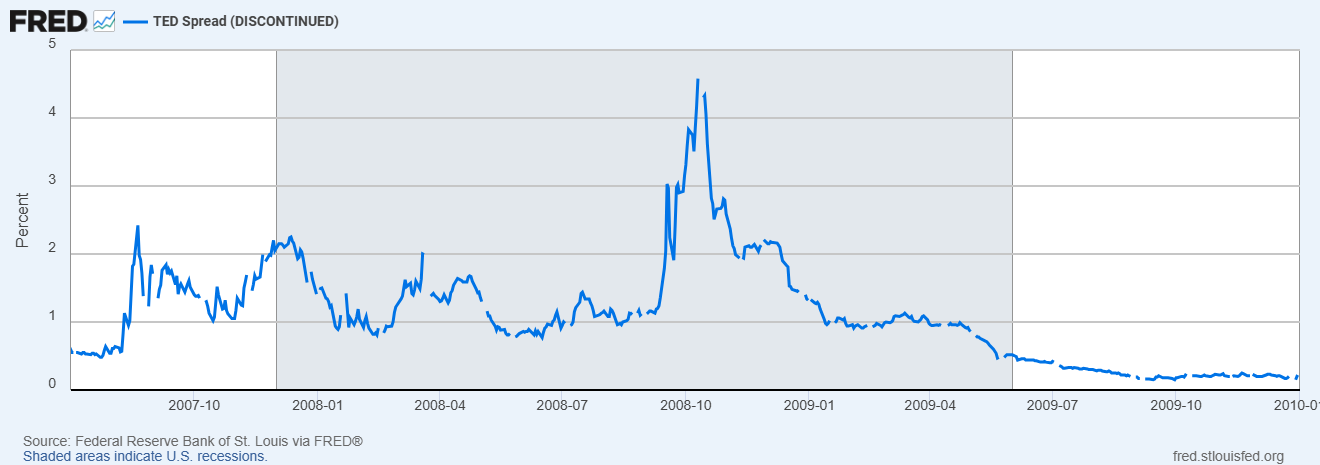
However, credit markets were showing warnings. This chart by the St. Louis Federal Reserve highlights the jump in credit spreads that were occurring at this time. Spreads would not return to this level for the long term until late 2009 after the worst of the crisis had passed:

August 10th, 2011 – Post-Downgrade Freefall
The summer of 2011 brought extreme volatility to Wall Street. Just days after Standard & Poor’s downgraded the U.S. credit rating, stocks were on a rollercoaster. August 10, 2011 saw the Dow Jones Industrial Average plunge 519 points (about 4.6%), erasing the huge relief rally from the day before.
This was one of three 500+ point drops within a single week, and the Dow had fallen more than 2,000 points on the week, more than 15%. The prior day (August 9th), the Fed had promised to keep interest rates near zero through 2013, initially sparking a big rebound. But that optimism proved fleeting. By Aug 10, focus shifted back to a “bleak landscape” of a weakening U.S. economy and Europe’s worsening debt crisis, and stocks sold off brutally once again.
Swings of several hundred points became commonplace during those days. Investors flocked to havens: gold prices hit record highs above $1,800.
The episode also produced one of the great ironies in market history. Even though it was U.S. debt that had just been downgraded, investors fled into U.S. Treasuries as a safe haven. The 10-year Treasury yield fell rather than rose, dropping from around 2.56% to 2.34% in the days around the downgrade and continuing to roughly 1.72% by late September.

Read of the Day
Lords of Finance: The Bankers Who Broke the World – A Pulitzer Prize-winning history following central bankers through WWI, the 1920s and into the Great Depression.
The book reveals how policy missteps after World War I sowed disaster. It’s an apt for our August 10th read of the day because it shows the immense pressure on early central bankers – much like 1914 – and draws parallels to modern crises. A sweeping, well-reviewed narrative, Lords of Finance imparts cautionary lessons about monetary orthodoxy and crisis management that resonate with every event on our list.
<– Go to Previous Day: August 9th: 1945 – Atom bomb dropped on Nagasaki
Go to Next Day: August 11: 1982 – Bell System Antitrust Breakup Approved